Elliptical Machine Design Evolution
Since their emergence in the mid-1990s, elliptical machines have continued to develop and evolve. Over the past three decades, different mechanical designs have emerged to shape pedal motion, resistance, machine size, and overall exercise experience.
The First Elliptical Machine
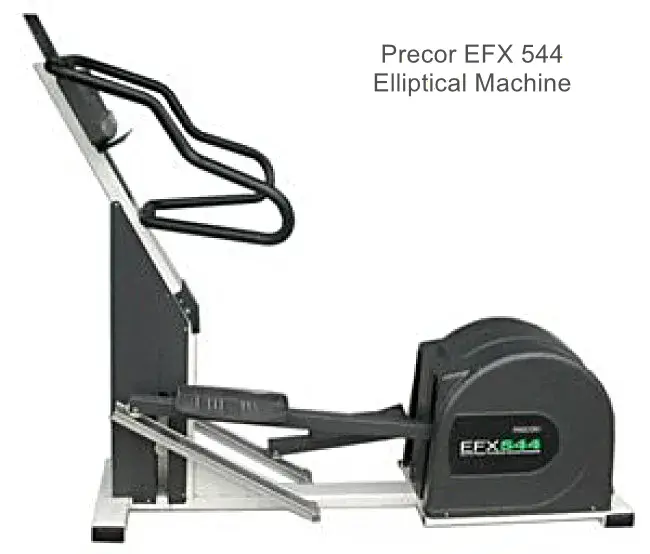
In 1995, Precor introduced the EFX 544 elliptical machine, which is generally considered the first elliptical machine to successfully enter the market.
The EFX 544 has a simple design — a crank-slide linkage system similar to a piston mechanism.
Each pedal is affixed on top of a coupler, with one end hinged to the crank and the other end sliding along a rail mounted on the machine frame.
The machine is designed with a stationary handlebar assembly.
The simple crank-slide linkage design was soon replaced by more advanced designs based on four-bar linkage mechanisms.
Four-Bar Linkage Design
In 1996, Paul William Eschenbach filed a patent that describes an elliptical exercise machine in which the elongated pedal path is generated by the coupler of a four-bar linkage.
The four-bar linkage design also introduced the cross-trainer concept with a pair of handlebars extended from the rockers.
This design gave the elliptical machine its classic characteristics: a long frame with a large rear flywheel.
Representative Models
- Life Fitness 8500
- Life Fitness CLSX
The Life Fitness Integrity Series CLSX is a recognizable example of the traditional rear-drive architecture. This model has been successful in commercial use.
Advantages and Limitations of Four-Bar Linkage Design
Advantages
- Simple, reliable, and durable
- No roller-slide and rail, more stable
- Few moving parts, less service
The four-bar linkage design is well suited for commercial use and remains dominant in commercial elliptical machines due to its high reliability and durability.
Limitations
- Large and heavy machine frame
- Constraints on pedal motion geometry design
The pedal follows an elliptical trajectory, predominantly in the horizontal direction.
Compromised Designs...
In order to make their elliptical machines smaller to attract home fitness customers, some manufacturers simply shrink the linkages and reduce the flywheel size, compromising the pedal motion geometry, resistance smoothness, durability, and exercise experience.
To overcome the geometry constraints inherent to the four-bar linkage design, the roller-slide/glide concept was brought back and integrated to the classic four-bar linkage design.
Roller-Glide on Fixed Rail Design
Roller-glide on fixed rail design was developed to allow more freedom in the pedal motion geometry design and also reduce the length of machine frame.
This design evolved from the classic four-bar linkage. Instead of having the pedal fixed to the coupler bar, a separate pedal bar is added and hinged to the coupler bar. One end of the coupler remains hinged to the crank, while the other end glides through a roller on a rail fixed to the machine frame.
With the pedal motion less restricted by the coupler position, this design brings a decent vertical lift, and proper tilt to a relatively short-frame elliptical machine.
Representative Models
- NordicTrack AirGlide Series
- Precor EFX546i / 885 / 835
- SOLE E25 / E95
Most front-drive elliptical machines adopt the roller-glide on fixed rail design. Some rear-drive models also adopt this design, like Precor EFX 546i.
Advantages and Limitations of Roller-Glide on Fixed Rail
Advantages
- Better designed pedal motion geometry, decent vertical lift
- Short machine frame
Limitations
- More exposed moving interfaces.
- Higher requirement on the machine construction and precision for reliability and durability.
- More motion freedom puts shear stress on bearings and couplings.
- Rollers can wear out prematurely.
- User assembly is more complicated, and assembly error can damage the machine in a short period of time.
Roller-Glide on Crank Design
Roller-glide on crank design uses a similar concept to roller-glide on fixed rail design to add additional freedom in pedal geometry design. The difference is that the coupler glides on the rotating crank.
Roller-glide on crank creates a long stride and short lift.
Representative Models
- Landice Elliptimill
Advantages and Limitations of Roller-Glide on Crank
Advantages
- Better designed pedal motion geometry, decent vertical lift
- Short machine frame
Limitations
- More exposed moving interfaces.
- Higher requirement on the machine construction and precision for reliability and durability.
- More motion freedom puts shear stress on bearings and couplings.
- Rollers can wear out prematurely.
- User assembly is more complicated, and assembly error can damage the machine in a short period of time.
Four-Bar Linkage + Transmission Design
In 2026, Bluemov LLC introduces a new design — Linkage + Transmission, with the launch of LB007 Vertical Elliptical Trainer.
Unlike the previous designs, in which the linkage system directly drives the flywheel, LB007 uses a two-stage transmission drivetrain to bridge the four-bar linkage mechanism and the flywheel. This allows the crank wheel to be positioned independently of the flywheel, giving designers much greater freedom to optimize the pedal motion geometry.
Advantages and Limitations of Linkage + Transmission Design
Advantages
- Better designed pedal motion geometry, decent vertical lift
- High kinetic energy - smooth resistance
- Broad resistance range
- No roller and track, better stability.
- Easy user assembly, and less error
- Compact machine
Limitations
- Complex structure
- Higher requirement on the machine construction and precision for reliability and durability.
Balancing Motion, Size, and Complexity
The evolution of elliptical machines reflects a continuing effort to improve pedal motion while making the machine more practical in size. From the original crank-slide design to four-bar linkages, roller-glide systems, and newer transmission-based designs, each architecture offers a different balance of motion geometry, size, simplicity, and mechanical complexity.
There is no single ideal mechanism for every application. A successful elliptical design depends on how these characteristics are balanced for its intended use.